Showing posts with label UKIP. Show all posts

Friday, 22 May 2015

2020: UKIP's choices

I come now to the most interesting of my surveys for 2020.  Labour and the Conservatives will be locked in their usual battle with each other.  The SNP sit at the top of a mountain of votes and if Scotland is still in the UK in 2020, their job will be to hoard them.  The Lib Dems need to pick themselves off the canvas, if they can.  But UKIP have important choices ahead of them, choices that will determine not just their own future but have a big impact on the future of the other parties as well.

Taking only one seat, UKIP underperformed their expectations.  Indeed, even in Clacton, their 7.8% majority over the Conservatives does not look completely secure for 2020.  If UKIP's support subsides, the Conservatives might wipe even Douglas Carswell off the electoral map.  UKIP's place in the peloton of British politics is insecure and that is not helped by the factional fighting that UKIP have descended into since the election.  The first choice that UKIP have to take is to remain focussed on the electorate. 

Let us assume that UKIP manage to overcome their current round of blood-letting. Where should they aim for next?  Here are their targets for 2020:

https://drive.google.com/file/d/0Bygi8eZw-4q1X3MzejJOTmQtQ00/view?usp=sharing

I hope that this table is largely self-explanatory.  I have highlighted the seat and the majority in the colour of the party of the incumbent.  I have also asterisked the majority if UKIP are in third, with an additional asterisk for each position that UKIP dropped below third.  Note that the boundaries may well change in this Parliament, so this list should not be taken too seriously and should be seen more as indicative than anything final.

Two things are immediately apparent.  First, UKIP has a long way to go if it is going to get significant numbers of seats in 2020.  And secondly, the bulk of its most tempting targets are in Labour-held seats.

A long long way to run

Yesterday I looked at the position of the Lib Dems and noted that a uniform 5% swing to them would yield the Lib Dems just 16 seats.  A uniform 5% swing to UKIP would yield them just four seats.  UKIP don't have the disadvantage that the Lib Dems have that they are losing an incumbency bonus in many of their target seats, which will make future gains for the Lib Dems harder. But a 5% swing is still a chunky swing.  This would be nearly a 50% increase in UKIP's vote on 2015.  UKIP should not underestimate the task that they have ahead. 

If UKIP got a uniform 5% swing towards them in 2020, they would be on just under 18% of the vote and would win just five seats.  On a smaller vote share in 1997, the Lib Dems managed 46 seats.  UKIP need to make sure that any increase in their vote is concentrated, not uniform.  So they are going to have to choose where to focus their efforts.  If they are to pick up more than a handful of seats, they are going to need to focus on a subset of seats relentlessly. 

Worse than that, UKIP will need to make progress in a congested field.  Note the number of asterisks on the table (yes, UKIP really are in seventh place in their 23rd target seat).  They're in third place even in their top target.  They are in fourth place as early as their eighth target seat.  They're going to have to muscle past other parties in most of their target seats if they are to increase their parliamentary representation. 

But what of all their second places?  There has been much mention of UKIP coming second in 120 constituencies.  And so they did: I lost a private bet as a result.  Here they are (the map was prepared by Kieran Healy of Crooked Timber and first featured here http://crookedtimber.org/2015/05/09/who-came-second-in-the-uk-election/):


Click on the map to enlarge it. 

But UKIP got their swathe of second places largely in very safe Conservative and Labour seats, where their vote wasn't squeezed and where the other main party was very weak.  It might conceivably be easier to get bigger swings in such seats than in seats where UKIP are third.  But they're hardly going to be particularly easy to win.

So UKIP is going to have to choose whether to prioritise getting the smallest swings or winning the most promising two horse races - or by some other means, perhaps by a geographical focus.  Its decision will lead to very different seats being targeted.

Who to go after next?

Look again at that list of targets by swing.  Five of the top ten targets are Labour-held, as are 13 of the top 20 targets and 25 of the top 40 targets.  (But three of the four seats vulnerable to a uniform 5% swing are currently Conservative-held).


This is not what was expected before the election.  Here is my last post before the election looking at UKIP's prospects:

http://newstonoone.blogspot.co.uk/2015/04/the-ukip-battleground-in-april-2015.html

Look at the list of UKIP targets organised by odds.  15 of what the bookies rated to be the top 20 UKIP targets were Conservative-held seats and only four were Labour-held seats.  Contrary to all expectations, UKIP did relatively far better in Labour seats than in Conservative-held seats.

This gives UKIP a dilemma.  They started life as a Thatcherite offshoot of the Conservative party, predominantly in southern England and their sole MP has characterised himself as a Gladstonian liberal.  Their initial boost in support came from the type of southern working class Conservative voters who voted for Margaret Thatcher's Conservative party and who were alienated by the smoother posher men who followed her.  But the type of policies that would appeal most in Labour-held seats would be much more economically leftwing in political outlook and much more northern.  Are UKIP's leadership prepared or even able to go in that direction to build up their newfound voter base?  Electoral logic pushes them in that direction.  But will they be guided by a different principle?

Eleanor Roosevelt famously said: "Great minds discuss ideas; average minds discuss events; small minds discuss people."  UKIP have spent all the time since the election discussing people when they should really be discussing ideas.  This is not just unedifying, it is a dangerous missed opportunity for UKIP.

UKIP have some big choices ahead of them.  They need to start thinking about them soon.  They will get nowhere without focus.

Sunday, 19 April 2015

The UKIP battleground in April 2015

It's time to look at the constituency betting markets as they currently stand from UKIP's perspective. So as at 13 April 2015, here's the table of all the seats where UKIP's chances are ranked by the bookies as 16/1 or better, ranked in ascending order of implied probability:


To recap for first timers, this table is compiled on the basis that in aggregate the constituency odds are our best estimate of what's going on, while noting that there may be individual anomalies (otherwise known as betting opportunities).  The constituency odds factor those matters in to the best judgement of bookies and punters. By arranging constituencies by order of odds rather than majority, we can see how many seats gamblers expect the parties to take - or what the odds are that each party will take a given number of seats.  

This is how things stood at the beginning of November 2014.

http://newstonoone.blogspot.co.uk/2014/11/the-ukip-battleground-in-november-2014.html

At that time, UKIP were soaring.  Since then, their prices have plateaued or even waned.  UKIP are favourites now in just three seats (down from five in November) and priced at under 2/1 in just seven seats, (down from nine in November).  UKIP were priced at under 10/1 in 42 constituencies in November, and that has now reduced to just 34 constituencies.  Some of this is explicable by prices in general becoming more competitive, but not all of it by a long way.  Whether or not UKIP have peaked in the polls, they have peaked at the bookies.  I shall consider later whether that is a correct reaction.

The decline in UKIP's fortunes has been exclusively as against the Conservatives.  In November, UKIP were priced at under 10/1 in 13 non-Conservative constituencies, exactly the same number as today.  UKIP have actually shortened their price in the one Labour constituency, Great Grimsby, priced at under 2/1 over this period.

UKIP do seem to have slightly come off their very highest points in the national polls and even the most ardent kipper would have to concede that they are not advancing further.  Some of the previous prices had been predicated on the possibility of UKIP continuing to improve.  That has not happened and their election campaign has not caught light.  The dreams of the most excitable kippers look set to be crushed.

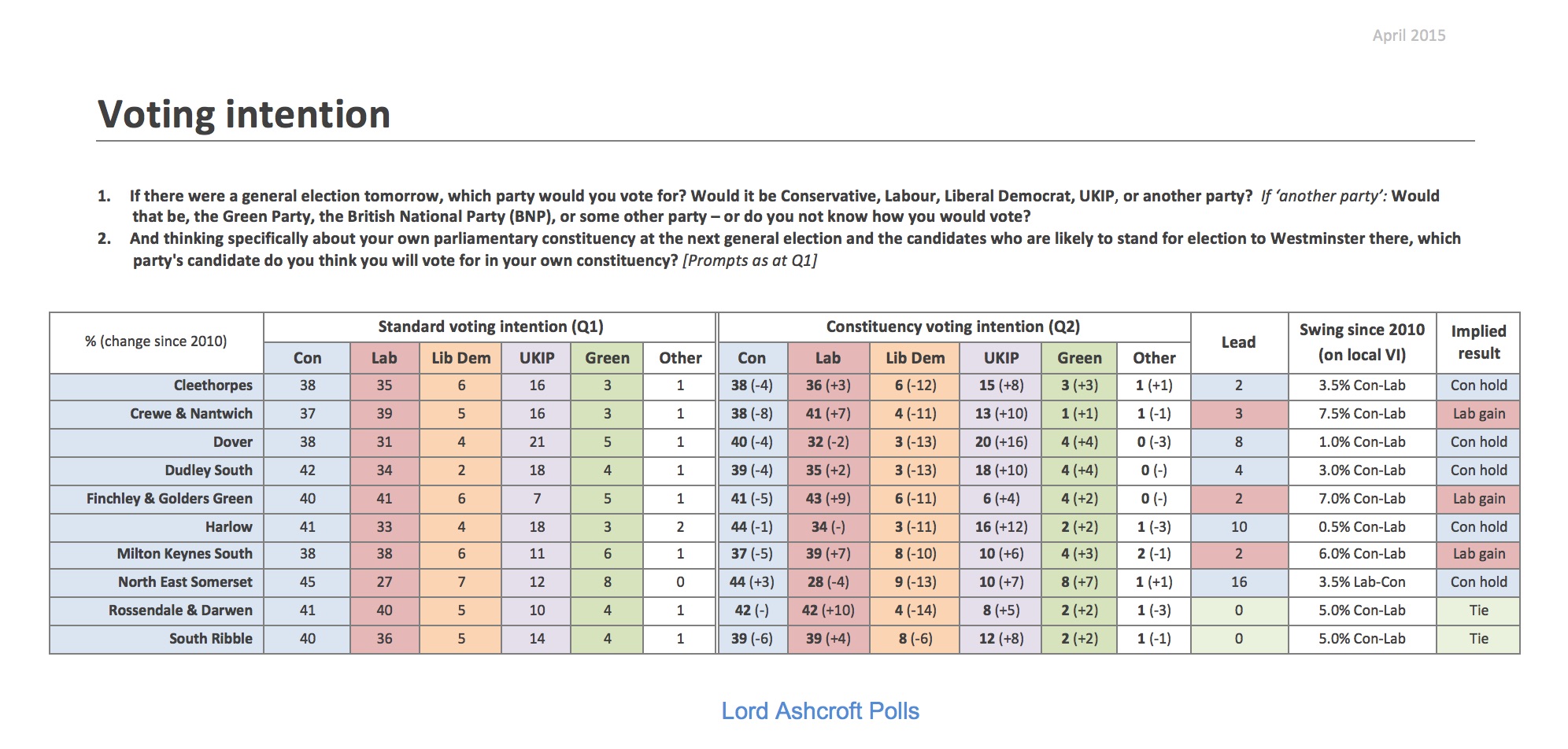
That means in turn that UKIP look most unlikely to take anything more than a handful of seats.  Recent constituency polling seems to confirm that (click to enlarge):


UKIP will be particularly disappointed in the polling in Dover, a seat where they had entertained outside hopes but where they seem to be coming a distant third.  They might well have hoped to be polling better in Cleethorpes and Dudley South too.

This means that UKIP's chances for the election are probably all gathered in those few seats where they are short-priced and the rest can probably now be forgotten about.  There is still the chance of an odd shock under the radar somewhere, but if it happens, it will be an odd shock not part of a clutch of victories.

As someone with a collection of UKIP longshot bets, this is disappointing, but I can hardly be simultaneously thrilled with the strong hope of success of longshot bets on the SNP and glum about UKIP longshots looking likely to be heading for the ashtray.  That is in the nature of longshot bets: they don't all come off.

I have called UKIP wrong at every point, discounting them before they surged, then thinking the surge would continue when in fact Rochester & Strood marked the end of that period of progress.  So I hesitate to give any advice at all, and you should discount my thoughts heavily given my track record.  But here goes.

Where UKIP are still short enough to affect the price of the others in the market without having a real chance of success themselves, there may be opportunities worth backing elsewhere.  So I am looking at those seats where UKIP are priced between 4/1 and 10/1 with that in mind.  I've backed the Conservatives in Folkestone & Hythe at 1/4 and Wyre Forest at 8/15 (closing out a three-way bet for a guaranteed profit).  I backed the Lib Dems in Eastleigh at 4/7 the other day, as I mentioned when I looked at the Lib Dem seat markets.  And I've backed Labour in Walsall North at 1/3 and in Newcastle-under-Lyme at 2/7 (as I mentioned when I looked at the Labour seat markets).

What of those seats where UKIP remain in with a shout?  My view of those is that they are seriously murky and that no one really understands how they are going to play out.  I am therefore proceeding with extreme caution in this final phase.  The 1/9 on UKIP in Clacton is a decent 1/9 shot though, as 1/9 shots go.

Thursday, 19 February 2015

Purples reined? The current polling and the betting implications for UKIP in 2015

By their usually noisy standards, UKIP have been quiet since the turn of the New Year.  Labour and the Conservatives have been knocking chunks out of each other on the NHS and tax avoidance, and their paroxysms over immigration have been forgotten for now.  What does that mean for UKIP's chances?
 
The polling
 
Is this period of subdued activity having any effect on UKIP?
 
We need to take this pollster by pollster, so that we don't get confused by differing methodologies.  But on this occasion, I'm afraid you're not going to get a clear answer.

Populus - since mid-November, UKIP have tallied between 12% and 16%.  Populus changed their methodology at the beginning of the month to prompt for UKIP.  Since then, UKIP have not polled below 14% with Populus, but we should be wary about drawing too many conclusions on a relatively small sample of five polls.

ICM - there is little pattern to UKIP's polling with ICM.  In the last year they have polled between 9% and 16%.  In the two polls since the turn of the year, UKIP have tallied 9% and 11%, but a sample of two is small.

YouGov - UKIP have tallied between 13% and 18% in 2015 so far with YouGov.  In the ten polls so far in February they have stayed in a tighter range of 13 to 16%. 
 
Survation - Survation are every kipper's favourite polling company.  Since the Euro-elections last year, UKIP have dropped below 20% with Survation just once and have hit 25% on one occasion.  The only poll so far this year from Survation has UKIP on a very healthy 23%.
 
Ipsos-MORI - Kippers are much less keen on Ipsos-MORI.  Since the Euro-elections, UKIP have polled over 15% with Ipsos-MORI just once and so far this year have polled 11% and 9%.
ComRes - ComRes show a more consistent picture than many pollsters, with UKIP registering between 15% and 19% in every poll since the Euro-elections.  In the two polls this year, UKIP have tallied 17% and 18%.
Lord Ashcroft - Lord Ashcroft has found UKIP in a 14% to 19% range ever since last May.  In 2015, this range has been 14% to 17%.
Opinium - Since the Euro-elections, UKIP have polled in a range between 15% and 21% with Opinium.  So far this year, UKIP have polled 20%, 18% and 15%.
TNS-BRMB - Aside from one poll where UKIP registered 23% in June, UKIP have tallied between 16% and 19% with TNS-BRMB since the Euro-elections.  The three TNS-BRMB polls this year have found UKIP polling 16% and, twice, 18%.

So in 2015, depending on which pollster you believe, UKIP could be as low as 9% or as high as 23%.  They could be seeing their support firm up if you believe Populus, or seeing it trend down if you believe ICM or Ipsos-MORI.

It is tempting to use an average or to try to proceed by consensus.  On this occasion, I believe that temptation should be firmly resisted.  We should not attempt to reconcile that which has been produced by methods which are incapable of reconciliation.  Ultimately, one approach is going to be right and others are going to be wrong.  We have four broad camps:

1) UKIP bears - ICM and Ipsos-MORI
2) UKIP glass half empty - Populus, YouGov, Lord Ashcroft
3) UKIP glass half full - ComRes, Opinium, TNS-BRMB
4) UKIP bulls - Survation

It is possible for all of these camps to be wrong and it is possible on the boundaries between these camps that two camps can claim to be right (camps 2 and 3 are not very far apart, for example).  But unless we see polling convergence in the last three months, at least two of these camps are going to be shown to have got UKIP wrong well beyond the margin of error.  Reputations are on the line.

In stark contrast to the Lib Dems, the pollsters have no consensus as to how to measure how UKIP are currently doing and whether UKIP are maintaining the progress that they made in the second half of last year. 

This is not the place to go into detailed analysis of the difference between different methodologies and their virtues (not least because the detail of that is well outside my knowledge).  I note only that good and reputable polling companies take very different views of how UKIP are doing right now.  If you are wise, you will keep your mind open to all possibilities.  We are in uncharted territory.

When we don't know where we are right now, it's much harder trying to work out where we might ultimately end up in May.  Even if you decide whether UKIP are going to hold steady, rise or fall, that information is of limited use if you don't know your starting point.

Constituency polling

There has been a lot of constituency polling.  Surprisingly little of it has focussed on seats of particular interest to UKIP.  Survation, at the behest of Alan Bown, have investigated the following seats: South Thanet, Eastleigh, Great Grimsby, Dudley North, Folkestone & Hythe, Bognor Regis & Littlehampton, Great Yarmouth, Rotherham, North Thanet and Boston & Skegness.  None of the Survation polls are particularly recent - the most recent ones are from last September.

Lord Ashcroft has surveyed the following seats (some of them twice) where UKIP were in contention:  Camborne & Redruth, Cannock Chase, Dudley North, Eastleigh, Great Grimsby, Great Yarmouth, St Austell & Newquay, South Thanet, Thurrock, Walsall North and Wyre Forest (and others where UKIP had hopes but which have not yet shown up particularly in the polling, such as Portsmouth South).  And today he unveiled results from South Basildon and East Thurrock, Boston & Skegness, Castle Point and Cambridgeshire North East.
 
UKIP have done well in many of these polls, but have a clear lead in only one: Boston & Skegness as conducted by Survation, where they registered a 20 point lead.  This contrasts with Lord Ashcroft's poll in the same constituency released today, which shows a small lead for the Conservatives.  We can't assume that there has been any kind of swing since September in this seat.  It may simply be differences in polling techniques. 
 
I have previously noted some peculiarities with the detail of the Survation poll in Boston & Skegness:

http://newstonoone.blogspot.co.uk/2014/10/surfing-purple-wave-ukip-general.html

In any case should not rely too much on any one poll in isolation and try wherever possible to look at polls in aggregate to guide us. 

Both Survation and Lord Ashcroft also conducted polls in the four by-elections since the Euro-elections in May, which enables us to perform a rough sense-check on the likely accuracy of these polls.  I set Heywood & Middleton to one side, since it appears fairly clear that there was a late sharp swing to UKIP - as both Survation and Lord Ashcroft are at pains to point out regularly, opinion polls are snapshots not predictions.

Survation overstated UKIP in their final poll in all three of the other by-elections - by 1% in Newark, by 4% in Clacton and by 6% in Rochester & Strood.  Lord Ashcroft overstated UKIP in his final poll in Newark by 1%, understated UKIP by 4% in Clacton and overstated UKIP by 2% in Rochester & Strood.  On this very limited sample it seems that in by-elections both do fairly well in estimating UKIP's vote share in by-elections, but that Survation's house style may consistently tend to overestimate UKIP by a little bit.  (Both Lord Ashcroft and Survation seemed to underestimate the Conservative vote share in these by-elections by a bit too.  This meant that the margin of victory was greater for the Conservatives than anticipated in Newark and lower for UKIP than anticipated in Rochester & Strood.  But in all three cases they both predicted the right result.)

It's very dangerous drawing too many inferences from a sample of three, and we don't know how this  effect will read across to general election results or whether we have similar house effects to watch out for. Nor do we know how reliably the national polls relate to the by-election polls.  But I very tentatively draw the conclusions that Lord Ashcroft's constituency polls may well be there or thereabouts for the UKIP share of votes at least, while the Survation polls may be a bit on the high side for them.

Placing assumption on top of assumption

I feel as if I am placing a chair on top of a table that is balanced on a beachball now.  I have tentatively assumed that Lord Ashcroft's constituency polls are there or thereabouts on UKIP's share of votes.  I also am assuming that the Conservative vote share in Conservative/UKIP marginals may be understated by a bit.  With these assumptions in mind, I guess that UKIP are in the lead in only one seat right now: Clacton.  Possibly it is ahead in Thurrock and Rochester & Strood also: we don't know.  UKIP will hope that South Thanet will fall to them with Nigel Farage's high profile, though it remains moot whether that will be an advantage.

Even if it is not leading in many seats, UKIP seems to be close to the Conservatives in a handful of other seats.  (We have no external information to judge how UKIP's polling results in Labour/UKIP marginals reflect the underlying position, even on the most tentative of bases.)

So while UKIP may on a best guess be a bit behind the Conservatives in its key targets, it is breathing down the Conservatives' necks hard.  Two things may help them overtake the Conservatives from here: a good ground game and any improvement in the polls between now and 7 May.

In general, we should expect the Conservatives to have a better ground game than UKIP.  They are longer established, should have better systems in place and are better resourced.  Set against that, what are now Conservative/UKIP marginals have previously been safe Conservative seats, so the Conservatives may not have anything like the information available in these seats that they would have in previously-identified marginals. 

Castle Point looks likely to be an exception to the rule.  It was the first seat ever to be represented by an MP under the UKIP banner and UKIP have the local support of a long-established and well-organised group, the Canvey Island independents.  Lord Ashcroft's poll shows a statistical dead heat and that currently UKIP are well ahead on the contact rate.  The Conservatives are going to have to pull out the stops to hold that seat.

For UKIP to get more than four or five seats, though, my current guess is that they are going to need to make progress nationally.  But I must stress that this is a guess based on some fairly flimsy assumptions.  There are many alternative readings of the current state of play that are entirely plausible.  If you vehemently disagree with me in one direction or another, I will not be matching you in my vehemence.  Unless there's such a thing as vehement diffidence.

What we don't know

There's a contrast to be drawn here with the position of the Lib Dems.  There is much that we don't know about how the Lib Dems are going to perform, but the general battle lines are understood.  The Lib Dems are going to poll nationally nothing like what they polled in 2010, but will be trying to rely on their local reputation in constituencies where they are strong to salvage what they can.  The national polling from each pollster tells an internally consistent picture over the last few months and the various pollsters don't differ all that much from each other.  We have had a lot of polling from Lord Ashcroft in specific constituencies and the uncertainty is about how to interpret this information, not in the sense of how does it read across but in the sense of how accurate the polling actually is.  In the broadest terms we expect that the Lib Dems are going to do very badly against the SNP and Labour, can hope to hold the line a bit better against the Conservatives and the uncertainty is how far along each of these fronts the Lib Dems will be able to hold up.

We have none of these certainties with UKIP.  The pollsters are poles apart in their picture of how UKIP is doing right now.  We have limited constituency polling of seats in which UKIP have an interest and because the various national pollsters have such a radically different view of how UKIP is doing right now, we can't be confident about how to put this constituency information into an overarching picture.  Worse, we have no track record of how UKIP performs in general elections rather than by-elections, so we don't know whether UKIP will benefit from or suffer from tactical voting or whether its vote will be squeezed.  We have quite a lot of information and all of it is confusing.

How to use that lack of knowledge

We are used to betting by interpreting the knowledge that we have.  But on this occasion we can say fairly definitively that we don't have a clear picture of what is going on at a national level, that we don't have a clear picture of how that might change by May and we don't have a  particularly clear picture of how that will map onto individual constituencies.


Should we give up?  No.  The right decision may ultimately be no-bet, but just because we don't know anything doesn't mean that's automatically the right conclusion without further investigation.  Betting is a process of managing uncertainty.  This is just a different kind of uncertainty. 

From the betting reaction to the most recent polls from Lord Ashcroft, which has seen UKIP prices lengthen and Conservative prices shorten in Castle Point and Boston & Skegness in particular, it appears that punters had got ahead of UKIP's actual progress.  There may be a ripple effect into other constituencies where UKIP are short priced, though I will not be following that bandwagon if it happens.  UKIP seem to be decentralised as a party and it seems dangerous to extrapolate too much from constituency to constituency.

If you're very bearish on UKIP's chances, Ladbrokes' over/under markets are worth considering.  For example, you can get 11/2 on UKIP getting under 1.5 seats.  That doesn't appeal to me at all because of the decentralised nature of UKIP's operation, but if you take the view that both Survation and Lord Ashcroft are presenting a bit too rosy a view of UKIP's chances, there are worse bets.  You're taking one view of the uncertainty around UKIP's chances that stems from the polling chaos if you place this bet.  So long as you appreciate that view might very well be wrong.

At the other extreme, at the end of November I was able to back UKIP getting under 19.5 seats at 1/3.  The price for that is now 1/10 and I could if I wished close out this bet for a profit by backing the other side of the bet at 6/1.  I'm not remotely inclined to though, because UKIP's route to 20 seats looks at least as problematic as it looked then, and time is running out for the kippers to find that route.  7/2 for over 9.5 seats looks a little more tempting, but I'm still not tempted.

I don't feel the need to back UKIP in any constituency just now, but equally I don't yet feel the need to close off my current bets.  My expectation is that UKIP will hit the headlines again during the election campaign and that they will be backed in accordingly in seats where they are thought to have half a chance.  Punters have already got a bit ahead of themselves once in this direction, so I hope that they will do so again.

I hope to see more of that type of enthusiasm in the election period and if so I will be aiming to take advantage of that, but will probably ultimately be closing off most of my bets where UKIP are in the mix.  I'd need to be a lot surer of my ground than I am at present to leave some of the short priced bets open.

So my current position is indeed no-bet as regards UKIP, but I hope that it's a positive no-bet.  My position may change soon enough.

Monday, 29 December 2014

Testing the boundaries (4): UKIP vs all-comers

As the final part in this series, I look now at UKIP's battles.  Although many kippers like to refer to LibLabCon as a single opponent, in fact its battles against each are a little different. 

I look at each in turn.

Conservatives

UKIP are in contention against the Conservatives in the following:


This table, as with the tables that follow below, is organised by the UKIP price of taking the constituency.  There is duplication between these tables because UKIP feature in many three and four way marginals.   Every seat where UKIP are priced at 16/1 or less is included.

For UKIP, this is the main event.  All five of the seats that they are favourites to take are currently Conservative-held and this list of targets is far longer than either of the other two battlegrounds.

If they are going to underperform in seat totals, by definition it must be in this battleground.  So we can consider each of these five seats one at a time.

Even in their bleakest moments, I very much doubt that UKIP fear losing Clacton.  Douglas Carswell appears to be a genuinely popular constituency MP and having retained a thumping majority at the by-election, he looks good value even at 1/10.

UKIP's next best hope is Boston & Skegness, where it is firm favourite following a Survation opinion poll putting them streets ahead.  The internal workings of that poll look a bit strange, but it would need to be very wrong indeed to justify betting against them. 

The other three seats in which UKIP are favourites are all triangular Conservative/Labour/UKIP battles: Thanet South, Thurrock and Great Yarmouth.  As we shall see, triangular battles are a feature of UKIP prospects.

Of these three, the Conservatives are UKIP's main rivals in Thanet South, Labour are UKIP's main rivals in Thurrock and in Great Yarmouth both main parties will regard themselves as in with a good chance.  There have been local opinion polls in all three (more than one in Thanet South and Great Yarmouth).  UKIP have been ahead in all three constituencies, though in the most recent poll in Thanet South the Conservatives had a small lead.

None of these seats are anything like certainties for UKIP.  Will tactical voting play a part?  In Thanet South, I expect the voting to be for or against Nigel Farage.  His national profile will generally be a plus, but there may be more voters than usual for UKIP who see this in personal terms and who wish to stop someone who inspires loathing in those that are not in the fan club.

I would not be betting on Nigel Farage at 8/13, which seems a bit too short to me.  I agree that he should be favourite, but given that he has at best a small lead and may be behind in the constituency at present, I would rate him only slightly better than evens.  If you can get on with BetVictor (I can't), you can back him at 4/5 to win a seat there.  That's a fair bet.  There looks to be a touch of value in the Conservatives at 15/8 and I've placed a small bet on this.  Note, with the BetVictor bet there is a small underround, so you should be betting on one or more of the main three parties.

Contrary to my original expectations, Thurrock has resolved itself into a two horse race between Labour and UKIP.  In such seats I expect to see UKIP having better luck getting tactical votes from the Conservatives than in seats where Labour are in third.  I like the 5/6 on UKIP with William Hill, but I'm already well-stocked up on UKIP in this seat.  Is the 9/4 on Labour also value?  The price looks about right to me.  I'm not yet ready to hedge though.

Great Yarmouth is a hard seat to call.  In an early example of what has become a trend, UKIP had an entirely avoidable selection scandal in this seat, picking a candidate who was subsequently charged with electoral fraud.  They now have a new candidate, Alan Grey, who looks more suitable.  However, their status as favourites is a bit odd, given that there have been three polls in the constituency and they haven't been ahead in any of them.  It is obviously going to be a confused seat, but if you asked me to price it, I'd suggest roughly 7/4 Labour, 2/1 the Conservatives and 9/4 UKIP, though I wouldn't quibble if you shifted the Conservatives and Labour around.  Anyway, either way Labour look like value and I'm on.

If UKIP are going to exceed expectations against the Conservatives, where might they do it?  It is apparent from the many constituency polls conducted where UKIP are in the mix that their performance varies very substantially from seat to seat.  It is curious that we have not had a constituency poll in Castle Point, where UKIP have a track record, have the support of very well-organised local independents and have a lively local candidate.  Without further information 11/8 is short enough.

We cannot complain about not having enough polls in Rochester & Strood.  The final poll in the by-election from Lord Ashcroft suggested that UKIP would win the by-election but lose at the general election.  This has been taken seriously by punters, with the result that UKIP are 13/8 to take a seat that they already hold.  I am already backing UKIP in this seat, but regard the 13/8 as a good price, given that Mark Reckless can use the remaining period of the Parliament to cement his incumbency with UKIP.  Opinion polls are snapshots not predictions, and UKIP gaining the seat alters the dynamics.

As I noted in the summer, UKIP stand a much better chance of getting to 35% and winning a three way marginal than they do of getting to 45% and winning a two way marginal.  In the absence of very specific on the ground information, I therefore ignore all those seats where UKIP are 16/1 facing an incumbent at 1/100.  UKIP might win such a seat, but I have no way of knowing where they're seriously in with a shot.

I prefer looking at seats where UKIP have multiple serious opponents.  Of the short-priced seats, the UKIP candidate in Dover has some brio and faces a Conservative opponent who has not handled UKIP astutely - I'm already on this seat though.  I backed UKIP at 25/1 in Wyre Forest (and NHS Action at 5/1), but I have concerns about Lord Ashcroft's poll in this seat, which prompted respondents for UKIP but not for NHA Action.  Since their candidate came second in 2010 and was the incumbent MP till then, that seems remiss.  The 1/2 on the Conservatives is now probably good value, given that NHA Action may well attract some of the protest vote that would otherwise have gone to UKIP.  I'm humming and hawing about this, but haven't placed it yet.

Among the longer shots, I have put a small amount on UKIP in Plymouth Sutton & Devonport at 16/1.  When Lord Ashcroft polled this seat in July, UKIP were in third and well behind Labour in first.  Since then, however, UKIP have picked up relative to Labour and this looks like the sort of seat where UKIP might have picked up support.  I note that UKIP are breathing hard down Labour's neck in Plymouth Moor View and I doubt this effect stopped at the constituency boundary.

For the same reason I've put a small amount on UKIP in Dudley South at 6/1.

Labour

On to the battle with Labour:


As I have already noted, there's a heavy overlap between this and the last list because of the number of triangular fights.  Because of the lower target percentage, these three way fights look more promising seats to me in general.  But let's now focus on the Labour-held seats in particular.

Since UKIP are not currently favourites to win any of these seats, they can only exceed expectations fighting against Labour.  And unusually, it seems to me that the markets are underestimating UKIP's chances.  Until recently, there was no real evidence that UKIP was making any significant inroad into Labour territory.  But that changed before Christmas when we got Lord Ashcroft's polling in four Labour-held UKIP targets:


In all four seats UKIP was even or ahead in the general polling question, and even when respondents were prompted to think of their own constituencies, UKIP were only a short neck behind in all four.  Curiously, prompting respondents to think of their own constituencies seems to have provoked some Conservative supporters to switch to Labour - evidence of some tactical voting?  But Conservative voters in these seats are a little less inclined to rule out voting for UKIP than for Labour.  Anyway, all four of these seats look tight and if UKIP are able to get more Conservatives to lend them their votes, they may creep over the line.  I'm already on the kippers in Rother Valley and I've added Dudley North and Plymouth Moor View to the roster.

Are there any other similar seats where UKIP may be worth a flutter?  I've put a small sum on UKIP in Newcastle-under-Lyme and Walsall North.  Both of these seats are also Labour-held with a moderate Conservative showing in 2010. 

The Lib Dems

Here are the seats where UKIP are head to head with the Lib Dems:


And what stands out is that there isn't really a separate UKIP-Lib Dem battleground.  Every seat except three on this list is on the Conservative battleground list, and the other three (Redcar, Ashfield and Rochdale) are on the Labour list.

That is good news when looking for UKIP bets, because as I have previously noted, triangles equal a better chance of power.  Some seats need close attention.  Lord Ashcroft and Survation have each conducted a poll in Camborne & Redruth.  Lord Ashcroft's poll in June showed UKIP in second place behind the Conservatives, while Survation's more recent poll in November shows UKIP in the lead.  The UKIP candidate's website suggests that he is rough around the edges:


"Robert believes our relationship with the European Union was based on trickery. The people were tricked in 1972 and are still being conned by both Conservatives and Labour."

However, I'm not too concerned about the quality of the candidate - UKIP voters are more interested in the feeling of the party rather than any specifics, it seems.  3/1 seems a fair price, even allowing for the fact that Survation are consistently the most UKIP-friendly of the pollsters.  I've made a small bet on UKIP in this seat.

Similarly, UKIP have been close enough to the lead in two different polls from Lord Ashcroft in St Austell & Newquay to make the 9/2 on them look worthwhile.

Finally, I found this a useful resource and you might too - details of UKIP's candidates in many of their most promising seats:

Monday, 3 November 2014

The UKIP battleground in November 2014

You're probably getting the hang of this now.  I've looked in turn at Labour, the Conservatives and the Lib Dems, and now it's time for my look at the constituency betting markets as they currently stand from UKIP's perspective.

So here's the table of all the seats where UKIP's chances are ranked by the bookies as 16/1 or better, ranked in ascending order of implied probability:


To recap for first timers, this table is compiled on the basis that in aggregate the constituency odds are our best estimate of what's going on, while noting that there may be individual anomalies (otherwise known as betting opportunities).  The constituency odds factor those matters in to the best judgement of bookies and punters. By arranging constituencies by order of odds rather than majority, we can see how many seats gamblers expect the parties to take - or what the odds are that each party will take a given number of seats.

These figures are up to date as at 31 October 2014.  There are no Scottish seats on this list, so the unavailability of the Scottish market is not a problem here.  This is a fast-moving set of prices and is already out of date in some respects (for instance, UKIP are now 5/1 in Rother Valley).  But I have to call a halt somewhere.

The first thing to note is how far UKIP have come in a very short time.  They are now odds on in four seats, favourite in a fifth and below 2/1 in three more, with no general election market in Rochester & Strood yet.  As recently as April, their shortest priced seat was Thanet South at 9/4.

You can get 1/14 with Corals that UKIP will get at least one seat.  This isn't so much a bet as a 7% tax free return over a six month period.  Corals, however, are not covered by the Financial Services Compensation Scheme.

You can get 8/13 with SkyBet that UKIP will get five or more seats and 4/6 with Paddy Power that UKIP will tally more than five seats.  At today's constituency prices, both prices are a bit too short.  But on what currently looks like the fairly safe assumption that UKIP takes Rochester & Strood in comfort, it seems more likely than not that there will then be one or more further defections to the kippers.  If so, these prices are unlikely to last.  Take these bets now.  You should be able to hedge them at a profit later if you think that UKIP are too short priced in the constituency markets.

UKIP now are rated at shorter than 10/1 in no fewer than 42 constituencies (including Rochester & Strood, which will undoubtedly feature in this group after the by-election).  And it is clear who UKIP are threatening most: 29 of these 42 constituencies are currently Conservative-held.

There are 129 seats on the whole list and the pattern continues with the longer shots. 79 are Conservative seats, 40 are Labour held and ten are Lib Dem seats.  Even if the Tories fend off UKIP, their impact could be fatal on the Conservatives in a different way - in eight of these seats Labour are priced at under 2/1 and Labour is at 5/1 or under in a further ten seats.  Splitting the right-wing vote might well be lethal to the Conservatives' chances of forming the government after the next election.

With UKIP prices continuing to come in fast, we in a bull market.  The question for now is not whether the prices are justified as what is going to happen next and are there going to be further shortenings such that we can hedge at a later date if necessary?  And the answer is clearly yes.  All you need to be an investment genius is a bull market and a short memory.  Time to develop amnesia and dive in.

After Rochester & Strood we can expect a spasm of further shortening of UKIP prices in a host of constituencies.  We can expect the particularly favoured constituencies to be Conservative-held seats on the Thames estuary and in Lincolnshire.  To ensure that I am able to hedge later if necessary, I'm choosing constituencies where UKIP are already quite short priced.  I've chosen Thurrock, Louth & Horncastle, Dover and Gravesham, but there's no magic in that choice of seats.   Right now, the key is to have made a good selection of UKIP bets.  I'm not worrying too much right now whether the price is right on fundamentals.  I should if necessary be able to lay them off at a profit later.

This is not exactly a complicated strategy.  But I see no reason for complexity at present when it comes to betting on UKIP.

Tomorrow, I turn to the SNP.

Friday, 10 October 2014

Surfing the purple wave: UKIP's general election prospects improve

It's time to look at how UKIP have done during the three months while I've been away.  But it's hardly as if I can claim any great insight here. I didn't see the durability of the UKIP surge and my expectation when I first wrote about UKIP in April was that they were likely to fade.  At that time, I wrote:

"It seems that the bookies are catering to the enthusiasm of the purple punters by relieving them of their money at poor odds."

At that time, only five seats had UKIP at odds of less than 10/1.  As of today's date, there are 28 such seats (and neither Clacton nor Rochester & Strood, which must both be among UKIP's best bets, have general election markets as of today).  So that shows how good a judge I was of how the wind is blowing.

I'll have to chalk that up to experience and I'll have to show some humility (there's a first time for everything, of course).  So let's leave the inferences aside and instead let's look at the current state of play.  Here are UKIP's prospects ranked in order of their present odds:


If we compare this to the position merely six months ago, UKIP have been the punters' darlings in the interim:


And here is the position in June - UKIP have generally shortened even since then (when 19 seats were at a price of less than 10/1):


I shall first try to look at where UKIP has been shortening.  Because the shortening prices have not been uniform.  UKIP are at the same price in Eastleigh as they were six months ago.  They're the same price in Castle Point and Louth & Horncastle as they were three months ago.  They've actually drifted out in Folkestone & Hythe in the last three months.  

So what's been happening in the markets?

1) Punters think that UKIP is developing local strongholds capable of being converted into seats.

Five Kent seats are priced at under 10/1.  There is no general election market for Rochester & Strood at present, and odds on that would certainly be below 10/1, whether or not UKIP ultimately wins its by-election.  Three more seats in the county are priced at under 16/1.  That's nine out of the 17 constituencies in the county - every coastal constituency in the county other than Canterbury and Faversham & Mid Kent.

Essex is a similar story.  Three constituencies are under 10/1 (not including Clacton, which looks like UKIP's best bet at the next election, but for which there is no market).  A further eight constituencies are priced at 16/1 or under.  So 12 out of 18 constituencies in Essex are seen as at least outside chances for the Kippers, including every coastal constituency except Witham.

Indeed, over the county boundary in London but still along the Thames estuary, both Dagenham & Rainham and Bexleyheath & Crayford also feature on the latest list of shorter priced UKIP targets.  The Thames estuary is hotting up for the purple team.

Incidentally, for those believing that UKIP is attracting None Of The Above voters from the Lib Dems, it's worth noting that the Thames estuary was one of the Lib Dems' weakest areas at the last election.  There isn't a single seat abutting the water from Bethnal Green & Bow to Castle Point on the north side inclusive and from Erith & Thamesmead to Gravesham on the south side inclusive where the Lib Dems tallie more than 15%.  There's more than that going on.

But it's not the only hotspot for UKIP.  Four seats in the old borders of Lincolnshire are priced at under 10/1, and a further three seats at 16/1.  That's all four of the Humberside constituencies south of the Humber and all three coastal constituencies in the new borders of Lincolnshire.  And indeed, most of the seats of what I have previously called the Saxon Shore feature in the list:


2) Punters are giving some love to the idea of UKIP making progress in Labour urban strongholds
 
Most of the shortest priced seats are Conservative held, but there are five Labour-held seats where UKIP are priced at under 10/1.  A further 21 Labour-held seats are priced between 10/1 and 16/1.
 
I must confess that I have found this price movement in particular difficult to follow, since no such constituency has had an opinion poll showing UKIP likely to take such a seat.  Even Rotherham, a seat whose recent history makes it as likely to consider an insurgent party as any such seat, has shown a double digit lead for Labour over UKIP in a recent Survation constituency poll.  This does not suggest to me that a general breakthrough in Labour-held seats is particularly plausible without a powerful new boost to UKIP's support among Labour's traditional voter base.

That said, the Heywood & Middleton by-election result does suggest a rethink may be necessary.  UKIP will need to think about how to harness the anger that they have undoubtedly found in such constituencies.
 
3) Punters are following the Survation and Lord Ashcroft constituency polls with interest
 
Alan Bown, on behalf of UKIP, has commissioned a series of opinion polls in individual constituencies.  11 have been made public (it is rumoured that several more have been commissioned in the seats of possible Conservative defectors, though I have no direct knowledge either way of this).  Additionally, Survation surveyed both Clacton and Rochester & Strood for newspapers.
 
These constituencies are Great Grimsby, Dudley North, South Thanet, Folkestone & Hythe, Bognor Regis & Littlehampton, Great Yarmouth, Crewe & Nantwich, Eastleigh, North Thanet, Rotherham, Boston & Skegness, Rochester & Strood and Clacton.   With the exception of Crewe & Nantwich, which had been included for control purposes anyway, all of these seats have UKIP at 8/1 or less. 
 
There is of course an element of circularity - Alan Bown had these seats polled because they were seen as serious prospects.
 
Separately, Lord Ashcroft has also been polling various constituencies.  He has not been focusing on UKIP particularly, but has looked at Great Yarmouth, South Thanet, Eastleigh (twice), Thurrock, Plymouth Sutton & Devonport, St Austell & Newquay (twice) and Camborne & Redruth.  Lord Ashcroft found leads for UKIP in South Thanet and Thurrock, but in neither of these cases were the leads substantial.  In Great Yarmouth, unlike Survation, Lord Ashcroft found that UKIP were a close second behind the Conservatives (Survation found the order to be UKIP, Labour, Conservative).  In Eastleigh, Lord Ashcroft (unlike Survation) found UKIP were a fairly distant third behind the Lib Dems and the Conservatives.  In the Cornish seats, Lord Ashcroft found that UKIP were second behind the Conservatives.  UKIP were a feature in Plymouth Sutton & Devonport without yet seriously challenging for the seat.
 
These findings have all percolated into the pricing of the individual seats.
 
And what's happening in reality?
 
If I knew that, I'd be a happy man.  We do not want for clues, but what is much harder is interpreting those clues.

Decoding the constituency polls
 
Let's start with the polling.  I find this really hard to interpret.  For starters, I have big reservations about constituency polls as a general concept.  It's one thing trying to get a balanced sample across the country, where pollsters have a lot of practice.  It's another thing trying to do so in a specific constituency where the appropriate balanced sample will differ quite significantly from that across the nation as a whole.  This problem is amplified where a new party is on the scene, with new demographic indicators to need to balance. 
 
Then there are the specific pollsters.  Let me be clear: I regard both Lord Ashcroft and Survation as reputable pollsters, honestly trying to get the most accurate results that they can.  Both do great work.  But we would expect different results from different polling companies with their different methodologies.  We need to understand that when interpreting these polls.
 
Survation in particular have consistently reported the highest levels of support for UKIP of any pollster when they conduct national opinion polls.  Lord Ashcroft's national polls also report UKIP at the higher end of the scale: his last five national polls record UKIP support at 18%, 14%, 17%, 17%, 17% (an average of 16.6%).  The UK Polling Report average at the date of writing is 15%.  Note, this does not suggest that either Survation or Lord Ashcroft are necessarily getting the wrong result.  But when judging UKIP's prospects in individual constituencies off the back of these constituency polls, we need to be aware that we are seeing the results presented in a light that is likely to represent the most hopeful view for UKIP.
 
Can we test Survation's and Lord Ashcroft's polling results?  Well, to a limited extent we can.  Survation's polls for the Euro elections overstated UKIP's tally by 5%. 
 
Both Survation and Lord Ashcroft produced constituency polls for the Newark by-election as well.  Both overstated both UKIP and Labour by a bit, and understated the Conservatives - in the case of Survation, by a lot.  Of course, there may have been further movements in voting intentions after the polls were taken, but that's easier to understand in terms of the Conservatives being understated and Labour being overstated if the Conservatives (and indeed UKIP) were squeezing Labour, and UKIP being overstated is a little harder to understand.
 
Both also produced polls for both the Clacton and the Heywood & Middleton by-elections.  These fared much better in Clacton (again Labour were a bit overstated by both, but both pollsters were more or less right about the Conservatives). Lord Ashcroft underestimated UKIP a bit, Survation overestimated UKIP a bit.

Heywood & Middleton was a very different story. UKIP did far better than either pollster had envisaged and the Conservatives did worse. In fairness, Survation stress in their poll that it's a nowcast not a forecast, and I expect Lord Ashcroft would say the same. Given that Nigel Farage reportedly stayed away from the constituency on the day because he thought that UKIP had no chance of taking the seat, it seems likely that there was a late swing to them that not even UKIP were expecting. Again, Labour's poll share was significantly overestimated. Perhaps it shows the difficulty of constituency polling and the dangers of relying on it too closely. 

Of course any opinion poll is just a snapshot of the current position.  Even where UKIP are in the lead, they may be overtaken by another party successfully securing tactical votes to keep them out. Or UKIP may, as in Heywood & Middleton, surge.

With all these notes of caution, these polls are still an invaluable resource.  And I am drawn to two bets on UKIP off the back of them.  If UKIP are 20 points ahead in Boston & Skegness, even with a pollster that discloses the most hopeful results for them, 10/11 on them is a very solid bet (I note that the odds have now shortened to 4/5, but it remains a good bet). 

One more note of caution in this particular constituency: the sample in the poll looks odd - on the face of it, barely a quarter of those polled voted for one of the Conservatives, Labour, the Lib Dems or UKIP in 2010.  But there's a lot of leeway for peculiarities in a 20 point lead.  I'm aware that isam of political betting likes this bet for the same reason, and he drew it to my attention, so I need to give full credit to him.

And 13/8 on UKIP in Thurrock looks like a good bet, given that Lord Ashcroft found that they were in the lead at present.   That may or may not be correct now, and they may or may not be overtaken.  But 13/8 on what on our best information seems like a front runner will do me.
 
Conversely, the 4/6 on Nigel Farage in South Thanet looks overdone.  With the Conservatives and Labour both apparently in hot pursuit if Lord Ashcroft's polling is to be believed, the risk that opposition to him personally might coalesce around one or other of these as a pre-capitation strategy looks substantial. 

What's happening on the ground?

Again, this is very hard to know from the outside.  The kippers seem chipper, and on those political blogs where they hang out, startling predictions are made of hoped-for gains that seem hard to credit.  But then, a 20 point lead for UKIP in Boston & Skegness is also startling.
 
From the by-elections, we can conclude the following:
 
1) The Conservatives' attacks on UKIP in Clacton were of no use whatsoever.  Be under no illusions: the Conservatives made a fairly significant effort, including a Prime Ministerial visit.  They had hoped to close the majority so that they stood a chance of taking it in the general election (I heard from two separate sources on the day of the by-election that they hoped to keep the majority below 5,000).  They did not, and indeed they seem to have had a poor handle of what was happening on the ground in reality. 
 
2) UKIP don't know their own strength.  The Telegraph reported today that "Mr Farage chose not to campaign in the seat on Thursday, having concluded weeks ago it could not be won."
 
 
If this is true (and I have no reason to doubt it), this was a serious mistake. It suggests that UKIP may miss some opportunities next year because of lack of good local knowledge.  UKIP have already released a list of target seats which looks eccentric in parts:
 
 
Aylesbury and Forest of Dean are not obviously in UKIP's top 12 best prospects (or even in their top 25). So far as I am aware, the wider list of 25 seats has not yet been made public.
 
This is important, because it means that we should downgrade UKIP's chances of taking seats unless, as in Clacton, they have good local ground information.  The evidence that we have so far is that, Clacton aside, they don't.
 
What's next?
 
It is hard to overstate the importance of the Rochester & Strood by-election for understanding UKIP's chances next May.  Douglas Carswell was in many ways the perfect defection for UKIP - a locally popular MP with a wider intellectual profile in a constituency with a ready audience for their message, able to take his team with him and to supply the ground game.
 
Rochester & Strood is much more typical, and will provide a good test bed both for future defections and for judging the reliability of constituency polls in Conservative-held seats challenged by UKIP.  Mark Reckless has a fairly undistinguished record in Parliament and does not seem to be a particularly popular constituency MP.  He had no wider profile until he defected.  If he wins well, the Conservatives should be very afraid indeed. 
 
What are my expectations?  So far, we have only had a Survation poll, though I expect that we shall have one from Lord Ashcroft soon enough.  On past reckoning, we might expect UKIP to be a bit overstated, the Conservatives to be a bit understated and Labour to be overstated.  If this is correct, the current state of play is a real cliffhanger.
 
UKIP are likely to be given a boost by their success in Clacton (success breeds success), and their odds will certainly shorten in the seat.  Will the Conservatives be able, as they apparently did in Newark, to squeeze Labour voters?  Will Labour voters simply sit on their hands, or will they break in favour of UKIP?  The Conservatives are certainly going to be going in very hard indeed, as they did in Newark.  Labour seem to have decided consciously not to try.
 
I could see this seat being decided by a few hundred votes either way as matters stand right now (with quite a wide span of results beyond that too).  UKIP should be favourites, but not overwhelmingly so.  The Conservatives look value at anything over 2/1 to me, so I'm laying UKIP this morning.  But I won't be betting too committally on this by-election: I'll primarily be waiting for its result.  Once we have that, I will make what I hope are considerably more secure assumptions about how UKIP will do in 2015.  It's unheroic, but prudent.  Sometimes not betting is the wisest course of action.  Given my track record on the trends with UKIP, it seems wise to me.
 
If you have strong views either way, conversely, you should be acting now.  If you think that UKIP are going to win well in Rochester & Strood, you should be backing UKIP in most of the seats in which they are short-priced and challenging the Conservatives.  If you think that the Conservatives are going to fillet the kippers in that by-election, do the opposite.
 
One final thought: unless you have inside information, betting on UKIP in seats on the basis that the Conservative incumbent is a possible defector is not for the faint-hearted.  I'm not playing that game - in general it looks like a sure-fire way to lose money.  I do note, however, that UKIP are 20/1 in Mid Bedfordshire...
 
That's one bet I'm not on though.

Monday, 16 June 2014

The latest election round: what have we learned about UKIP? Part 3: the wild card effect

So far I have looked at the recent round of election results from the perspective of UKIP's own chances of winning seats. Now I shall look at what the data from these election results implies for the other parties' chances. This comprises two elements: where and who.

Where
 
Well, it now seems clear that UKIP voters are going to be found in many areas in significant quantities. While I am sceptical of their abilities to win many (or even any) seats, they are going to be active players across the eastern side of England, in the north midlands, along the south coast and in the south west.  They are also going to rack up votes, if not seats, in Yorkshire and north east working class constituencies.

Some of these seats will be two way fights between an incumbent and UKIP: I would ordinarily expect UKIP of standing little chance of getting the sort of vote share that would cause a strong incumbent any jitters.  But UKIP are going to gatecrash a host of two way and three way marginals, pulling votes from the serious contenders in unpredictable ways.

This is potentially very profitable for those can identify who this is going to benefit.  Or very expensive if you don't spot an undercurrent.

Who

One difficulty in working out the impact of this is that UKIP voters are come in several different types.  I've already taken one look at this:


While I have been considering the "who" question on a national level for some time, I had not given too much thought to how the background of UKIP voters intersected with individual constituencies until prompted to do so by an observation of another_richard in the comments section on www.politicalbetting.com.  Put another way, much attention has been given to the nature of the coalition of voters that UKIP is putting together.  Far less attention has been given to how other parties' coalitions are being affected by this.

Others will be able to do this with far more psephological accuracy than me, but as it happens I doubt that would be particularly helpful for betting purposes.  We only need a rough idea.  So with the sort of precision that you could find only in a saloon bar, I set out a cariacature of the previous coalition of each party.

Labour: unionised workers, public sector workers, lower paid workers, the workless, those from ethnic minorities, professionals who are progressive values-driven.

Conservatives: professionals (other than those who are progressive values-driven), higher paid workers, the self-employed, home owners, the elderly, the battlers.

Lib Dems: localists, professionals who are progressive values-driven, protest voters.

UKIP have put together a coalition built on very different lines, comprising those intellectually hostile to the EU, the socially conservative, those hostile to immigration, those in low paid work and protest voters. These cut across former party boundaries.

Labour is vulnerable to losing lower paid workers and some of the workless, while other parts of its coalition, such as those from ethnic minorities or progressive values-driven professionals, are most unlikely to be tempted to vote purple next year.  In some geographical areas, this barely affects the Labour vote.  We saw that Labour had a very good performance in London in May, reflecting the fact that Labour's vote here largely comes from the UKIP-resistant part of Labour's coalition.  Its vote similarly held up well in the Core Cities.   Because of the shape of their coalition, they are likely to lose little of their vote in university towns to the Kippers (helping to explain the short prices on Labour in Bristol West, Leeds North West and Cambridge).

But in areas where Labour's vote is much more drawn from those in lower paid work, UKIP appear to have undermined Labour's efforts.  They lost control of both North East Lincolnshire and Thurrock. Labour also seem unclear how to identify the categories of voters that they have lost with any precision: in Swindon they won the popular vote but went backwards in seat count.  Labour is likely to lose disproportionately high shares of its coalition in less urban and less well-educated workforces.

If Labour have problems with UKIP, the Conservatives have bigger problems still.  UKIP has bitten a big chunk out of its battler vote - the lower paid workers who have philosophy of self-reliance and who have modest aspirations.  This is especially a problem in Essex and Kent for the blue team, but a problem everywhere for them.  Those intellectually hostile to the EU tend to be fewer in number and more evenly spread.

The Conservatives will also lose proportionately more of their vote in less urban and less well-educated workforces.  Some seats are going to be like a slow bicycle race in reverse, where the party that loses fewer voters to UKIP will take the seat.  In such seats, if in doubt then the assumption has to be that Labour will lose fewer voters than the Conservatives, simply because the Conservatives have been losing more voters to UKIP than Labour have.

Overall, the rise of UKIP is good for Labour in its battles against the Conservatives, but there will be some very different results in different seats.

The Lib Dems have seen their coalition splinter into three.  Its share of progressive values-driven voters has largely decamped to Labour, while the protest voters have taken their protest elsewhere, either to Labour or to UKIP.  In seats where the Lib Dems finished third in 2010, the effect of UKIP picking up the protest vote will be irrelevant on the seat count: the race in such seats will remain between Labour and the Conservatives, and that switch of protest will not affect that race.

Where things get interesting is where former Lib Dem voters were half localists, half anti-metropolitan protest voters.  This was a relatively common combination in the south west and the risk of even some of these voters moving to UKIP is potentially very dangerous for the Lib Dems, where they hold a string of seats with small majorities over the Conservatives.

How to tell how this is playing out in individual seats?


Ah yes, I was hoping you weren't going to ask me that.  Whoever gets that right is going to be highly in demand.  I don't think I've got it remotely right yet (though I don't think anyone else has either).

I do have some ideas though.  In the Labour/Conservative marginals, I'm working loosely on the basis of "low education, high education, public sector/private sector".

In areas with high rates of people with no qualifications (the average rate for England & Wales is 23%, we can expect both the Labour and Conservative vote to be fraying in the direction of UKIP.  Where the jobs are disproportionately to be found in the public sector, we can expect the Conservatives to suffer more heavily from this than Labour, and vice versa when the area's jobs are disproportionately in the private sector.

In areas with high rates of people with degree level qualification, I expect the relatively few professionals who are UKIP-friendly to all come from the Conservative side of the fence.  But when you find such high rates in an area which also has high rates of people with no qualifications, the impact of UKIP - whether in favour of Labour or the Tories - is likely to be magnified.  A seat centred around private sector employment and lots of people with both no qualifications and degree level qualifications is likely to have a Conservative-voting middle class and a Labour-voting working class, making the seat more favourable to the Conservatives than it might otherwise appear.  A seat centred around public sector employment and lots of people with degree level qualifications is likely to have a Labour or Lib Dem-voting middle class and thus Labour will be more UKIP-resistant.

You can do your investigations on local authorities here:


It's laborious, but valuable.
 

Betting implications
 

This is all very well, but what does this mean for betting purposes?  The important thing to remember is that UKIP's rise is already taken into account in the polling, so we only want to be making further adjustments where there is going to be a disproportionate impact one way or the other.

The Labour/Conservative marginals of most interest are those where the Conservatives' coalition is relatively less damaged, simply because the Labour individual constituency prices are on average not as good value as betting on Labour getting most seats or an overall majority.  (Labour may be value at 2/1 in Great Yarmouth, however.)

As an example of potential differential impact, another_richard drew attention to Sherwood as a seat where Labour's support was largely working class while the Conservatives' support was much more drawn from middle class professionals.  The east Midlands has other such marginals (Erewash and North West Leicestershire) and similar seats can be found elsewhere, such as Swindon South and Milton Keynes South.  The Conservatives in Erewash at 6/4 look interesting.

The other battleground that needs reassessment is the south west.  To date, the focus has been on the extent to which the Lib Dems could retain tactical Labour votes.  If the Lib Dems are going to lose a slew of votes to UKIP as well, seats that looked safer will look much less safe.  The Conservatives are odds against in North Devon and St Ives and evens in North Cornwall.  They look worth backing in all three. They should perhaps be firmer favourites in some other seats in the region too.

This is very much dipping a toe in the water, and others will have more and probably better ideas how to tackle this.  Given that UKIP is going to be a disruptive force up and down the country in 2015, it is essential to have a strategy for factoring in its impact when betting in individual constituencies. Ignoring it is not an option, unless you want to lose money.